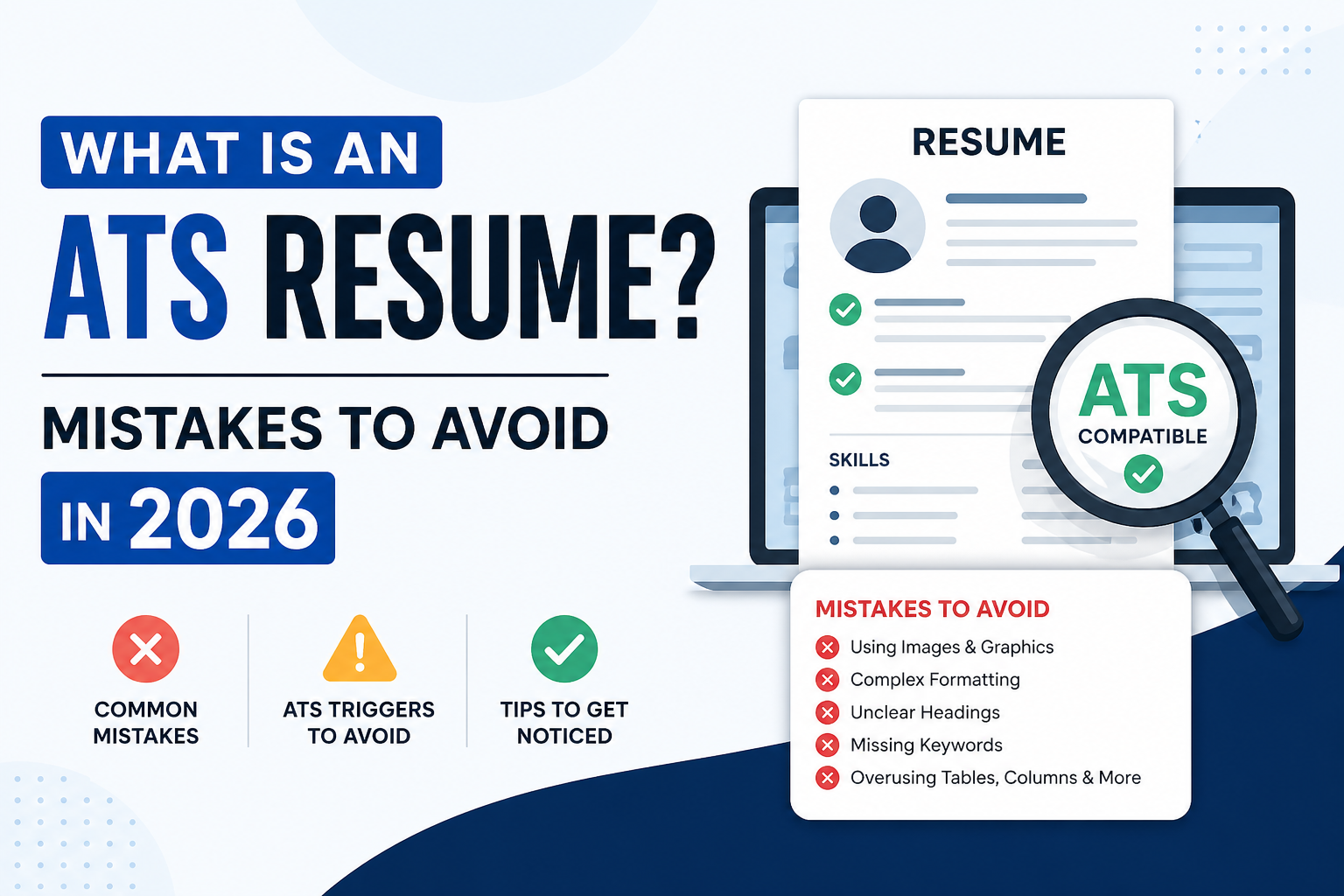
You spent hours writing your resume. You applied to dozens of jobs. And then… silence.
No calls. No emails. Nothing.
If this sounds familiar, you are not alone. Millions of job seekers face this exact problem every single day. The frustrating truth is that most resumes never even reach a human being. They get filtered out by software before anyone reads a single word.
That software has a name. It is called an Applicant Tracking System, or ATS. And understanding what is an ATS resume is honestly one of the most important things you can do for your job search right now.
This guide will walk you through everything in plain, simple language. No confusing tech talk. No corporate jargon. Just clear and honest advice that actually helps.
So, What Is an ATS Resume Exactly?
An ATS resume is a resume that is written and formatted in a way that can be easily read and understood by Applicant Tracking System software.
When you apply for a job online, most medium and large companies use ATS software to handle the flood of applications they receive. This software scans your resume, pulls out key information, and scores it based on how well it matches the job description.
If your resume scores high enough, it moves forward. If it does not, it gets rejected automatically. No human ever sees it.
According to research by Jobscan, over 98% of Fortune 500 companies use ATS software to screen candidates. And smaller companies are catching up fast too.
So when people ask what is an ATS resume, the short answer is this: it is a resume built to survive the robot filter first, so a real person can read it second.
How Does ATS Software Actually Work?
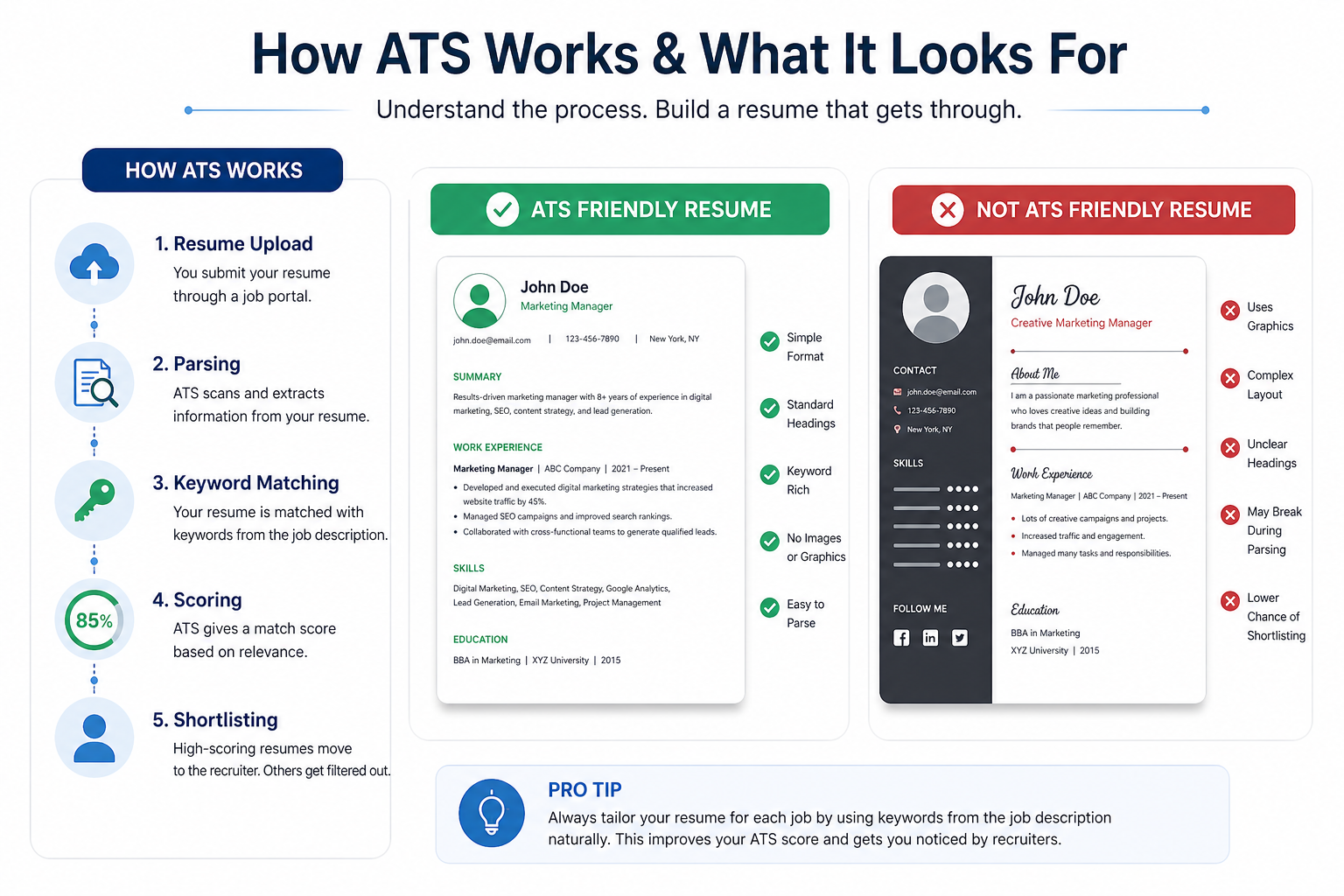
Think of ATS software like a very basic but powerful search engine. It looks through your resume for specific words and phrases that match the job posting.
Here is a simple breakdown of what happens when you hit that apply button:
Step 1: Your resume gets uploaded into the ATS system.
Step 2: The software parses your resume, meaning it breaks it down into sections like your name, contact info, work history, skills, and education.
Step 3: It scans for keywords from the job description.
Step 4: It gives your resume a match score.
Step 5: Resumes above a certain score move to the recruiter. Resumes below that score get filtered out.
The whole process takes seconds. And if your resume uses fancy graphics, tables, or unusual fonts, the ATS might not be able to read it at all. That means an instant rejection even if you are perfectly qualified.
Why Most Resumes Fail the ATS Test
This is where a lot of people go wrong. They design a beautiful resume with columns, icons, and colorful headers. It looks amazing to the human eye. But the ATS sees it as a jumbled mess and cannot parse it correctly.
Here are the most common reasons resumes get rejected by ATS software:
Using images or graphics instead of real text. ATS cannot read images.
Using tables or text boxes. These confuse the parser.
Using creative or unusual section headers like “My Journey” instead of “Work Experience.”
Not including the right keywords from the job description.
Submitting a resume in the wrong file format, like a .pages file instead of a .docx or .pdf.
If you have been wondering why am i not getting interviews, there is a strong chance your resume is getting blocked by ATS before it ever reaches anyone.
What Makes a Good ATS Resume?
Now that you know what is an ATS resume and why it matters, let us talk about what a good one actually looks like.
A good ATS resume is clean, simple, and keyword-rich. Here is what to focus on:
Use a Simple, Clean Format
Stick to a single-column layout. Use standard fonts like Arial, Calibri, or Times New Roman. Avoid headers and footers because ATS often skips those sections entirely.
Use Standard Section Headings
Label your sections clearly. Use headings like “Work Experience,” “Education,” “Skills,” and “Summary.” Do not try to get creative here. The ATS is looking for familiar labels.
Match the Keywords in the Job Description
Read the job posting carefully. Notice the exact words and phrases they use. Then use those same words in your resume naturally. If the job says “project management,” do not just write “managed projects.” Write “project management.”
Keep It in a Compatible File Format
In most cases, a .docx file works best with ATS software. Some systems also handle .pdf files well, but it is worth double-checking the job posting for any specific instructions.
Avoid Special Characters and Symbols
Things like stars, checkmarks, and decorative lines look nice but can confuse ATS parsers. Keep it simple and text-based.
A Quick Comparison: ATS Resume vs. Traditional Resume
| Feature | ATS Resume | Traditional Resume |
|---|---|---|
| Format | Simple, single-column | Often multi-column or designed |
| Keywords | Matched to job description | May not include relevant terms |
| Graphics | None | Often includes icons, charts |
| File Type | .docx or plain .pdf | Any format |
| Goal | Pass software screening | Impress a human reader |
| Section Headers | Standard labels | Creative or unique headings |
The good news is you do not have to choose between a resume that impresses software and one that impresses humans. A well-written ATS resume can do both, as long as you write it thoughtfully.
How to Find the Right Keywords for Your ATS Resume
This step is where most people either get it right or completely miss the mark.
Keywords are the words and phrases that show up in the job description. Your job is to mirror that language back in your resume without making it sound robotic or forced.
Here is a simple three-step process:
Step 1: Copy the job description into a plain text document.
Step 2: Highlight the skills, tools, and qualifications that appear most often.
Step 3: Work those terms naturally into your resume, especially in your summary, skills section, and bullet points under each job.
You can also use tools like our ATS Resume Scanner to instantly see how well your resume matches a job description. It highlights missing keywords and gives you a clear match score so you know exactly what to fix.
Tools That Make Writing an ATS Resume Much Easier
You do not have to do this alone. There are tools built specifically to help you create and check your ATS resume without the guesswork.
Our ATS Resume Generator is designed to help you build a properly formatted, keyword-optimized resume from scratch. It walks you through each section and makes sure your resume is structured in a way ATS software can actually read.
And once your resume is ready, run it through the ATS Resume Scanner to see your match score before you apply. Catching problems before submission saves you a lot of wasted time and frustration.
Common Myths About ATS Resumes
There are a lot of wrong ideas floating around about what is an ATS resume. Let us clear a few of them up.
Myth 1: You need to stuff keywords everywhere. Not true. Keyword stuffing actually hurts your chances because when a human finally reads your resume, it sounds unnatural. Use keywords in a way that reads smoothly.
Myth 2: ATS systems are only used by huge corporations. Not anymore. Plenty of small and mid-sized companies now use affordable ATS tools to manage applications.
Myth 3: A creative resume always stands out. Not if it never gets seen. A beautiful resume that gets filtered out by ATS is not helping you at all.
Myth 4: Once you pass ATS, you are guaranteed an interview. Not quite. Passing the ATS filter just means a human will read your resume. You still need strong content and relevant experience to get that call.
Quick Checklist Before You Submit Your ATS Resume
Before hitting submit on your next application, run through this quick checklist:
Is your resume in a simple, single-column format?
Did you use standard section headings?
Have you included keywords from the job description?
Is the file saved as a .docx or compatible .pdf?
Did you remove all images, graphics, and special characters?
Have you run it through an ATS scanner to check your match score?
If you answered yes to all of these, your resume is in great shape.
Final Thoughts: Do Not Let a Bot End Your Job Search
Here is the bottom line. The job market is competitive enough without letting an automated system quietly toss your resume in the trash. Understanding what is an ATS resume gives you a real edge over other applicants who are still submitting resumes that were built for a different era.
The goal is simple. Write clearly. Use the right words. Keep the formatting clean. And use the right tools to make sure your resume is ready before it hits any system.
Your next opportunity could be one well-optimized resume away.
Ready to take action? Try our free ATS Resume Generator and ATS Resume Scanner today. And if you found this helpful, share it with someone who is also wondering why am i not getting interviews. It might be the answer they have been looking for.